
How to Design Joints for High-Vibration and Heavy-Load Environments
In most assemblies, threaded fasteners are standard practice, yet they are mechanically inferior in one crucial respect: subject to prolonged vibratory and dynamic loading, they lose clamp force catastrophically. Understanding why bolted connections fail, and how to design against it, is the difference between assemblies that require routine maintenance and structures that incur expensive failures on site.
How transverse vibration leads to joint degradation
The self-loosening of a bolt under transverse, or side-wise, vibratory loading is properly called the Junker effect. It’s not as mysterious as it sounds – Junker’s test is specifically designed to quantify the loss of clamp force from a standard bolt under transverse cyclic loading (perpendicular to the bolt axis). What makes it happen is that the bolted joint surfaces tend to slide relative to each other with each cycle of vibration. This motion is too small to perceive, but it’s enough to cause a loss of friction between the contacting surfaces, ultimately allowing the bolt to spin completely out of the joint.
According to DIN 65151 Junker test results published below, the loss of preload can amount to a total loss of clamp force from a standard bolt after just 100-300 cycles of transverse vibration. In a piece of equipment subjected to continuous vibration, 300 cycles may not be enough time to complete a single revolution of a rotating shaft. On a structural frame, the effect can be just as insidious – once the clamp force of a joint is lost, localized bending moments cause lug edges to bear an increased load that induces fatigue cracking along hole edges. These cracks propagate until even more load is transferred to the edges of the holes, inducing catastrophic failure.
Shear vs tensile: what is the difference?
The vast majority of joints are subject to a combination of shear and tensile excitation. The difference between the two is intuitive enough – loads applied laterally to the fastener shank are shear, while tensile loading pulls the joint members apart along the shank axis.
Shear dominates in high-frequency structures like rotating machinery, and it manifests via relative sliding motion of the joint faces – the self-loosening mechanism described by Junker’s test. A fastener with high shear strength will resist this motion, preventing the self-loosening mechanism from occurring. If the joint has lost clamp force, however, the ability to resist tensile excitation becomes paramount. When a fastener is pulled apart by tensile loading, it is said to have lost preload. A joint’s ability to resist being pulled apart is its preload; thus, a loss of preload dramatically reduces the fastener’s ability to resist tensile excitation. In fact, preload is responsible for almost all of a joint’s resistance to tensile excitation across the clamped interface.
In practice, this means that the relationship between torque and preload is vitally important in threaded assemblies. However, it is rarely completely predictable. The friction characteristics of the joint, which affect torque, change across different materials, lubricants, and operators. Since torque is a direct measure of the preload, too little torque results in an insecure joint, while too much torque can damage the joint or over-stress the fastener. Worse yet, the relationship between torque and preload is non-linear, and two identical fasteners may exhibit different torque-preload characteristics due to process variations. As a rule of thumb, you should assume that two fasteners torqued to the same specification in production may have different starting preloads that vary by as much as 20%.
Degradation modes of threaded fasteners – and why they matter
When it comes to threaded fasteners, the most immediately obvious mode of joint degradation is the stripping of threads. In practice, however, thread stripping is a secondary mode of failure that is almost always preceded by a loss of preload.
Loss of preload, sometimes called joint relaxation, happens for three reasons, primarily due to embedment of the clamped joint surfaces. First, the surfaces of metal parts that have been pressed together will conform to each other’s irregularities on a microscopic level. Second, on painted surfaces, the paint at the contact spot will be crushed to about half its thickness. Third, day and night temperatures are rarely equal, meaning that all structures cool down slightly as the day ends. These three factors combine to reduce the fastener’s clamp force.
The embedment process always begins at the highest points of the contact patch, which means that the initial clamp force applied to the joint will always be higher than the final clamp force observed. Some joints are known to relax by as much as 30% before reaching operating conditions. In the context of a vibrating structure, the loss of preload described above can be seen as a Junker-type cycle, causing a complete loss of clamp force and subsequent self-loosening. Split washers and threadlocking fluids mitigate the problem by providing a small friction torque that must be overcome to rotate the fastener. At the same time, neither split washers nor threadlocking fluids are totally effective at eliminating relative rotational motion at the interface, and both are unreliable in field service.
As a rule of thumb, all threaded fastener joints require re-torque programs to stay secure in high-vibration service. Such programs are an operational expense for any structure that uses large numbers of threaded fasteners in its construction.
Permanent joints: the design and advantages of lockbolts and structural rivets
Permanent fasteners are easy to understand from a mechanical standpoint: if the relative motion between the fastener and the hole is what causes loss of preload and subsequent degradation of the joint, the obvious solution is to make that relative motion impossible.
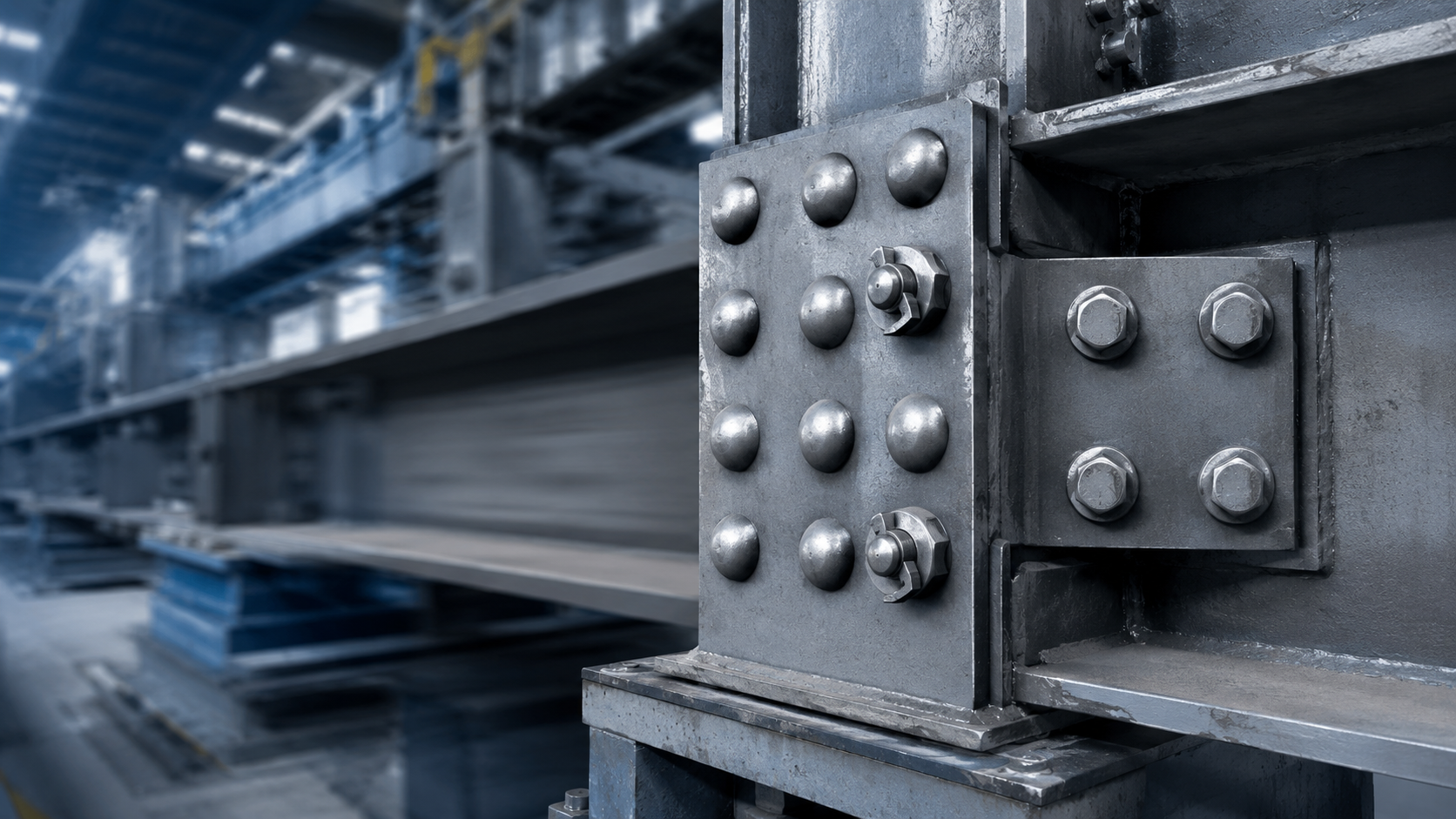
Lockbolts are two-piece mechanical fasteners that have two distinctive features: a pin and a collar. During installation, the collar is driven into circumferential mechanical grooves on the pin shaft, thus locking it against rotation. Lockbolts eliminate three critical failure modes for the joint: rotation of the fastener (and thus loss of preload and self-loosening), reduction of preload from embedment, and preload loss due to friction decay.
Meanwhile, the process of driving the collar into the pin during installation generates a large amount of clamp force that can be reliably predicted. Since the collar driving force is a function of the hydraulic pressure that swages the collar, lockbolt installation is insensitive to the skill of the installer compared with torque-tightened locking devices. In other words, each fastener in a lockbolt joint will perform identically, within the tolerances of the installation equipment.
One notable example of a permanent fastener system is Huck Bolts, which are two-piece mechanical fasteners specified by the aerospace and heavy equipment industries for their predictable performance characteristics in vibration. Similar to lockbolts, Huck Bolts are driven in a way that makes their installation force totally independent from the installer’s skill level while providing substantial clamp force.
Structural Rivets are another type of permanent fastener similar to Huck Bolts that are ideal for achieving structural integrity when only one side of a joint is accessible (blind-side installation). High-strength structural rivets generate massive clamp loads while filling the entire diameter of the hole for superior bearing strength. They are an excellent method of joining heavy workpieces when access is only available from one side, and they allow for making strong connections without the need for highly-skilled welders and the inspection infrastructure that goes with them.
Across the types of permanent fasteners, one factor remains the same: a connection that derives its shear strength from the friction of the clamped joint will always be weaker than one that derives its strength from mechanical bearing on the inside diameter of the hole, and fail sooner when subjected to vibration. The predictable performance characteristics of permanent fasteners make them ideal in high-vibration machinery and for structures that cannot afford to have their joints degraded over time.
Material considerations and galvanic corrosion
When choosing the material for permanent fasteners and threaded inserts, there are two major factors to consider: dissimilar material expansion coefficients and galvanic corrosion.
The reason dissimilar expansion coefficients are important has to do with joint relaxation caused by differential expansion of the joined parts. The principle is easy enough to understand – when installed, a fastener will always be subjected to thermal cycles due to ambient temperature variations, and a differential expansion coefficient will add extra stresses to the joint. A fastener made of carbon steel in a carbon steel structure will not be subject to differential expansion, while a stainless-steel fastener in an aluminum structure will be.
Galvanic corrosion is a separate issue altogether, stemming from a set of circumstances where two metals with differing electrochemical potential are both exposed to an electrolyte. When exposed to rain or another conductive liquid, an electrochemical potential difference between two metals manifests as current flow, and the circuit can be completed through the joined metal parts, causing corrosion.
The best way to avoid galvanic corrosion is to ensure that the electrochemical potential difference between the fastener material and the material of the joined parts is minimized, where possible. Alternatively, if the use of dissimilar metals is unavoidable, insulation between the joined materials will prevent corrosion.
Grip range and hole prep: two design considerations that are frequently overlooked
Grip range and hole prep are two aspects of joint design that are frequently overlooked by engineers but can be absolutely critical to reliable performance when designing a heavy-duty joint.
Grip range refers to the total thickness of material a fastener can safely clamp. Within the design limits, a given fastener should be able to develop a clamp force equal to its torque rating across the thickness of material specified by the manufacturer. When a fastener is under-gripped (too little thickness is clamped within the fastener), its clamp force, torque rating, and tensile strength are reduced. When a fastener is over-gripped (too large a thickness is clamped), its torque rating is reduced, and it often fails completely due to insufficient tail length to engage with the thickness of material.
Hole prep is the other critical consideration, as the dimensions of a hole cut into a metal sheet determine the characteristics of a joint as a whole. The importance of hole prep cannot be overstated. Oversized holes will reduce allowable shear loads due to reduced bearing area under the fastener head or collar, while poorly deburred holes will have stress concentrations on their edges that significantly reduce the fatigue life of the joint.
These considerations are especially important for permanent fasteners like lockbolts and structural rivets, which derive their shear strength from the bearing area of the hole. For this reason, hole tolerances should be held to a maximum of +/- 0.1 mm in structural joints, and holes should be deburred on both sides before installing any permanent mechanical fastener.
Quality control and inspection considerations
Torque specification is the standard quality control procedure for threaded fasteners, and it is a fundamentally flawed procedure. Torque is a measurement of rotational force applied to the fastener, not the clamp force itself. It serves as an approximate reference for the amount of preload in the joint, but the relationship between torque and preload is highly variable and non-linear. For this reason, a given amount of torque can result in wildly differing amounts of preload in different joints.
Permanent mechanical fasteners, by contrast, are much simpler to inspect. A lockbolt joint is inspected by measuring the formed collar or tail of the pin on each fastener in the joint – inspection is a matter of checking if the fastener falls within tolerance. When installed correctly, the fastener will behave exactly like an identical fastener installed the day before; there is no inspection ambiguity caused by differences in friction or installation environment.
For high-stakes structural joints, advanced non-destructive testing (NDT) procedures may be required, including ultrasonic verification of bolt load or dye penetrant inspection of joint surfaces. These procedures are primarily used in the aerospace and railroad industries to ensure that critical joints are safe and fit for service, but the cost-benefit analysis often favors them in any application where the consequences of a failed joint are unacceptable in the operating environment. Simpler inspection procedures are a key advantage of mechanical fasteners over high-strength permanent threaded fasteners.
A joint, once formed, should require minimal maintenance to remain durable and safe. The reasons discussed in this article demonstrate why a permanent mechanical joint is a better choice in most cases for high-vibration structural assemblies. The predictable behavior of lockbolts and rivets under cyclic loading make them a reliable choice for inspection, and the superior clamp retention allows such connections to resist loosening and degradation.
Choosing the right fastener for a high-load joint is not just a design consideration; it is an engineering requirement. By specifying permanent mechanical fasteners correctly, engineers can ensure predictable, reliable performance of a joint in high-vibration service.